Tuesday, December 28, 2010

Annie Hall

It's hard to believe 33 years after the fact that Star Wars could have possibly lost out on the award for best picture of the year. After all, it's one of the most famous movies of all time and it completely changed the science-fiction genre and filmmaking in general. However, Annie Hall did indeed win the prestigious award that year largely due to its witty writing and endearing story, which spectacularly captures the era of the 1970s. I generally believe that most romantic comedies tend to be overly sappy and aren't really funny at all, but this one actually does come off as being humourous and entertaining.

Annie Hall involves the unlikely relationship between Alvy Singer and Annie Hall. Woody Allen plays Alvy Singer, a Jewish comedian who is constantly nervous and fumbling, states the obvious even when he shouldn't, and has an obsession with death while Diane Keaton plays the role of Annie Hall who is incredibly carefree and naive in her mannerisms. From the outset, the relationship between the two is shown to be rather tumultuous and uncomfortable as it falls apart on several occasions. Given how the two are essentially opposites of each other this is hardly surprising, but what intrigued me about the movie is how it generally focuses on the positive aspects of their relationship even though it's established near the beginning of the film that it ends poorly. The story shows that happiness can be found even in the strangest of scenarios as I can assure you the interactions between Allen and Keaton here are like few you've ever seen before. Their dialogue really takes the spotlight in this one as there are hardly any other performances of note in this movie as the whole film revolves around the blossoming and eventual implosion of their relationship. The outcome of the story is obvious since the movie begins with the end, but I really liked how it flashes back to the beginning point in their relationship so the audience can get perspective on everything that happened up until that point. I particularly enjoyed the specific scope this movie has as it focuses entirely on their relationship rather than extraneous factors, which is good because the short runtime of the movie didn't leave much room for exploration of anything else.

Annie Hall moves at a fast pace and it's pretty much over in the blink of an eye. With a runtime of only 90 minutes, there were two ways to go about making this movie: it could've skimmed the surface on several topics ultimately amounting to nothing, or it could go into a deeper examination of one particular idea. Fortunately, Allen devotes the whole film to exploring the peculiar and awkward romance so I do feel like it had a purpose and direction to it, yet I can't help but feel that if the movie were perhaps 30 minutes longer it could have been more meaningful. The movie ends so quickly that it feels like it was just a blur watching it, and perhaps that's what Allen was intending as he could've been trying to point out that not only are our relationships seemingly short, but the life in which they occur is also a blur and you can look back once in a while and wonder where all the years have gone. Annie Hall doesn't really leave any burning questions unanswered, but I still felt kind of empty after watching this movie since it seemed as though it could have further explored the breakdown in the relationship and the factors causing it as they weren't looked into much during the film.
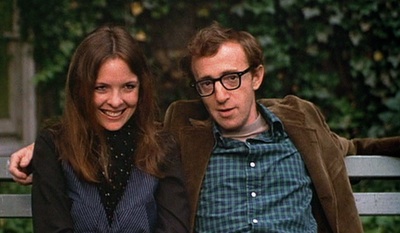
One of the unique aspects of this movie is the way in which it captures the essence of an era. Annie Hall is really a snapshot of the 1970s as it captures the physical image from that period with characters who are dressed like people of the time, but more importantly it really showcases the individualistic spirit that was burgeoning at the time. Annie Hall herself is the perfect embodiment of the 1970s thought current as she hardly has a care in the world and feels a type of spiritual connection with the world that was common during that time. The movie's authenticity doesn't have the same effect on someone like me who didn't live during the time; however, it's still really interesting to get an idea of what it was like back then, and Annie Hall gives the era a gorgeous representation. The movie conveys this sense of a connection to the 1970s and is almost on par with Forrest Gump in being able to take snapshots of history and give them meaning within a fictional context. Annie Hall certainly doesn't have the same social impact today that it did over 30 years ago, but if you're looking for a movie that gives insight into the 1970s, I'd be hard pressed to think of another movie that really illuminates the time quite like this one does.

Annie Hall does a fantastic job of taking a unique love story and putting it into the context of the time in which it took place. You'll find that you make a connection with both Alvy and Annie as their wacky relationship takes several twists and turns that make for an entertaining experience. The movie is over in a flash, but it's authenticity and portrayal of an era give it staying power and make it larger than just the simple story upon which it revolves.

Wednesday, December 22, 2010

Braveheart

Braveheart gives you everything you would expect out of the typical blockbuster movie. The film has an epic runtime of 3 hours and features some intense and heart-pounding battle scenes. However, there is also some substance behind the flashy action as the movie conveys a very powerful message and there is rarely a dull moment during the experience.

One of the most obvious strengths in Braveheart is its sheer scope and ambition. Not surprisingly, there is plenty of violence and warfare throughout the film as it is meant to show one nation's struggle to achieve independence from the control of a tyrannical state. The battle scenes are always intense regardless if it's simply William Wallace fighting off a few soldiers by himself or grandiose thousand member armies clashing. The major battles in Braveheart are flashy and large-scale as they are very reminiscent of Lord of the Rings style engagements. Furthermore, the movie as a whole moves along at a steady pace and there is rarely a down moment in the movie that feels out of place or boring as the huge action scenes are usually curbed at about 15 minutes so they don't drag on for an inordinate period of time and the story is actually interesting to follow so I actually felt emotionally invested in the battles since they represented more than just the best special effects that money could buy at the time. I also found that the movie does an excellent job of really spacing out the battles with meaningful story telling. There were only a couple of fights between large armies with character development and story building forming the bulk of the film's formidable runtime. The story gives depth and meaning to Wallace's quest to liberate Scotland and actually provides the viewer with some perspective on what's going on so that the movie doesn't just equate to a collection of cool-looking, but ultimately pointless fights. I found that the movie peaked at just the right times so that the combat stayed fresh and interesting, but I also never found myself bored with the larger context of the actual storyline.

While I enjoyed Braveheart on the whole, I did find that the ending to the film was incredibly predictable and it was also overdone at points. If you watch this movie, you'll never really find yourself in doubt about how everything will turn out as the way the movie plays itself out is pretty typical and doesn't really break any new boundaries or leave itself open to interpretation. That being said, there are some unexpected twists and turns along the way that spice up the plot and keep the movie moving along so it doesn't become so predictable that you're inclined to stop watching altogether. Additionally, I felt that the film became somewhat overdramatized at points where it felt like the movie was trying to be really deep and powerful at points where doing so just wasn't effective at the time. It's kind of hard to explain this sort of feeling about the movie to those who haven't watched it, and it may be a matter of personal opinion, but it just seemed to me that it tries too hard at points to be an amazing movie where it really doesn't need to because Braveheart is quite good and it just seems to be a bit over the top at times. 

The intense battles and the epic atmosphere surrounding Braveheart have become a cherished aspect of the movie for good reason. However, the major production value and work that went into making the movie would have been rendered almost completely meaningless if there wasn't an engaging and captivating story to back it all up. Braveheart involves the story of William Wallace, a commoner who is distraught over the personal hardship that the rigorous British rule over Scotland has brought upon him. His response to these dire circumstances is to fight against them in whatever capacity possible, and like a snowball rolling down a hill he soon finds many others joining his cause to do the impossible and gain independence. It's important to note though that he doesn't just mindlessly fight whoever he can whenever he can, but rather he stresses the importance of having the mental strength, endurance, and wherewithal to be able to keep fighting and never lose perspective of what the fighting is for. I really like how the movie reminds the viewer that it's not really what we have, such as our brute physical strength, that makes us who we are, but it's more our mental fortitude and what's within us that emits the real power that can be harnessed and called upon come battle time. When you watch this movie you'll find yourself sympathizing with Wallace's cause and being drawn into the experience as you hope he can fight the power and win the freedom we all desire. Ultimately, being able to draw the viewer in and have him/her relate to what's going on in the story is the strongest attribute that any movie can have as it's this relation that allows the viewer to perceive the greater message and really feel impacted on a personal level.

Say what you want about Mel Gibson's personal views, but he certainly knows how to put together a quality product as he directs and stars here. Braveheart features a combination of awe-inspiring and thought provoking storytelling with entertaining and epic battle scenes. The movie hardly ever lets up and even though its conclusion is ultimately predictable and obvious, the movie on the whole is fantastic and definitely appealing to the average moviegoer.  

Sunday, December 19, 2010

To Kill a Mockingbird

As most people are aware, To Kill a Mockingbird is based off Harper Lee's highly successful novel bearing the same name. The book has been given a great deal of credit over time for good reason, but the movie adaptation is also excellent, thus I feel it is worthy of being judged on its own merits.

Not surprisingly, the first thing I noticed with the film is that it's shot in a vintage black and white style. This intrigued me at first as the movie came out in 1962 so the technology was obviously available to shoot the film in full colour since many movies before its time were done in such a fashion. Yet, there's a certain appeal to the movie that comes with the old style. By making the backgrounds within every scene so mute and mundane, it encourages the viewer to look past the presentation of the film and instead focus on what's actually taking place. The background of the movie seems to symbolize how boring the world actually is when you only gaze briefly at what's going on in the surface as there's simply so much more present if you take a closer look, thus if all you're looking for is a big blockbuster special effects film than I strongly recommend you steer clear of this one. Ordinarily, I would say that most movies need to boast captivating visuals, or at the very least colour, in order to liven up the action and intensify the experience as a whole. However, To Kill a Mockingbird is a rare case where this doesn't apply as the brilliant story and performances delivered in the movie are more than adequate to hold the viewer's attention.

The story of To Kill a Mockingbird explores the extremes of human behaviour. On the one hand, you have the noble Atticus Finch who is willing to defend an innocent black man in his trial even though he has no hope of winning his case and will be scrutinized for going against the wishes of society. On the other hand, the film depicts the general population as being completely ignorant and unwilling to move beyond their prejudices. Throughout the film, it's easy to wonder why Atticus never physically confronts these people as he is clearly opposed to their behaviour, yet he simply tries to talk to them even though he knows his words will inevitably fall upon deaf ears. Atticus clearly carries  a certain level of physical strength and intimidation, which is best displayed when he shoots a dangerous animal from a great distance to the amazement of those around him who thought his only talent was his ability as an orator. This is meant to show that while a physical attribute such as being able to accurately fire a weapon is admirable, the far more under-appreciated role of inducing change through non-violent measures is much more difficult, but also stands as the only outlet through which change can be attained in a civilization where brute strength is valued since physically harming others would only serve to uphold these invalid morals. Although the movie is focused on the issues of racism and ignorance, Boo Radley presents an interesting paradigm within the film. While racism is an issue that extends far beyond the boundaries of this movie, Boo Radley is the character who best represents the plight of southern American black people during this time. He is clearly misunderstood by those around him because he is seen as being insane relative to the general populace just as members of racial minorities are misunderstood and perceived as being strange. This misunderstanding and misconception can clearly be associated to a fear of the unknown. To Kill a Mockingbird really analyzes the depth to which society has allowed racism to exist because of this fear, and the movie becomes more provocative as this analysis is carried out.

In addition to its riveting storyline, To Kill a Mockingbird features some great acting performances. First and foremost, Gregory Peck is at his finest here as his long courtroom speeches are as emotionally profound now as they were almost 50 years ago. Peck's confident tone certainly serves the film well as he really gives off the persona of being an incredibly headstrong and determined person which is needed to play the role of Atticus Finch in his opposition to the general current of thought at the time. However, Peck is also able to speak intellectually and eloquently to prove that he not only has the strength needed to oppose adversity, but also has the wit to overcome it. The child actors in this play also deserve some praise as they really capture the sense of curiosity that most children have. In particular, the first half of the film explores this element where the kids try to spy on Boo Radley because they are curious and want to push the limits just like most normal children do at points. Fortunately, the film avoids the common pitfall with young actors where they turn out to be overly annoying and actually detract from the movie. The kids here are far more endearing and I wish more of the movies from our current generation would look back upon this movie as a stellar example of how to properly incorporate inexperienced child actors into a movie without them being whiny and overbearing.

To Kill a Mockingbird features a combination of engaging storytelling with convincing acting. The old black and white style of the film gives it a unique character and really encourages the viewer to look past the plain backgrounds and instead follow the far more important plot. I strongly recommend this film to anyone who enjoys the novel or anyone who wants to watch a timeless piece of dramatic cinema. Remember: Tis a sin to kill a mockingbird, but it is also a sin to not watch this incredible movie yourself.

Saturday, December 11, 2010

Philadelphia

Overall, I found Philadelphia to be a pretty good movie. I thought the film was captivating for the most part, and while I wasn't blown away in awe by the film, there were many understated moments that allowed me to pause and reflect on the state of discrimination in my own society.

I felt that the acting was certainly the strongest point of the film. Not surprisingly, Tom Hanks is given a great deal of credit for his performance as Andrew Beckett, an aspiring homosexual lawyer who not only has his physical life cut short by AIDS, but also his career is destroyed by the social diseases of bigotry and misunderstanding as he is wrongfully dismissed by his employers because of his condition. The physical implications of his ailment are obvious and need not really be discussed, but what I really liked about the movie is how it gives insight into far bigger social ramifications. The horrors of homophobia were really exposed and I wondered if we really have progressed so much as a society since 1993 when Philadelphia was released or if there has in fact been little change. It's pretty ironic that Beckett is so quiet and reserved about his life given that many people have the misconception that homosexuals try to force their nature upon other people and can't control their emotions. Philadelphia clearly undermines this notion by showing that homosexuality doesn't present a threat to society, but rather the ignorance and hatred that many people have in response to homosexuality is the real problem. However, this isn't to say that Tom Hanks delivers the only memorable performance in the film. I really enjoyed Denzel Washington in his role as Joe Miller, an initially homophobic lawyer who only takes Beckett's case for wrongful dismissal as a means through which he can boost his own reputation and image. Miller's loudmouthed and blunt nature really contrasts with the personality of Beckett as he is able to articulately voice Beckett's grievances against those who have wronged him. Although Miller is shown to be unreceptive and misinformed at first, his transformation by the end of the film resonates a positive message and gives hope that others can change as well.

While I appreciated that the film didn't try to shove a moral in my face and left the ending open to interpretation, I still feel like there were points where the movie kind of dragged. The constant switching between the court hearings and the personal lives of both Beckett and Miller was effective at times, but the movie also lost some momentum at these points. Often I found that the movie was building towards a powerful conclusion during the court scenes, but then it would revert to a past part of Beckett's life that wasn't really related to what was going on in the main plot. I felt that some of the flashbacks had nothing to do with Beckett's condition, and really had no contribution to the message of the film involving ignorance and discrimination. Thus, the action and intensity of the film would be interrupted with events that were fairly irrelevant and served little purpose other than lengthening the film's runtime. Honestly though, this is a fairly nitpicky point and if you watch the movie it doesn't happen too often, but when it does it's annoying.


One aspect of the film I enjoyed is how it delivers a positive message at the end by showing that we all have the power to change, and that it is never too late to right a wrong. I was particularly impressed that the film managed to leave me with a positive and heartwarming feeling given that the main character is inflicted with an ailment that he has no hope of recovering from. Thus, while the movie shows the inevitability of physical death and decay, it also performs the far more important task of showing that it is possible to overcome adversity even in the face of the most bleak outcomes such as combatting AIDS. The transformation of Joe Miller throughout Philadelphia really punctuates the message that the movie tries to send. Even though this is Andrew Beckett's story, Miller is a crucial component for representing society. Miller's final speech in court is evidence of his evolution as he is able to overcome his initial distrust and skepticism of Beckett in order to combat the far bigger scourges that plague our civilization. This movie gives me hope that we can become a more accommodating and understanding society over time.

Philadelphia isn't the most awe-inspiring or intense drama. However, the film featured some great performances and left me with a sense of satisfaction because it gave me hope that we have the capacity to change for the better. This is certainly a movie worth watching, and I especially recommend it to anyone who likes any of the other Tom Hanks dramas.